
- Since 2016Local Charlotte buyer since 2016Local Charlotte buyer since 2016
- Any conditionWe Buy Cars In Any ConditionWe Buy Cars In Any Condition
- 1,000s boughtThousands of Vehicles PurchasedThousands of Vehicles Purchased
- Cash on pickupCash Paid On PickupCash Paid On Pickup
- Free towingFree Same-Day TowingFree Same-Day Towing
- Charlotte metroCharlotte, Mecklenburg & Surrounding AreasCharlotte, Mecklenburg & Surrounding Areas
Damaged Car Buyer In Charlotte
We buy damaged vehicles throughout the Charlotte area, including collision, flood, hail, and fire damage. The car does not need to be drivable. Free towing included.
Get your free cash offer
- Front-end, rear-end, and side collisions
- Hail, flood, fire, and rollover damage
- Total loss and salvage titles welcome
- Insurance payout too low? We often pay more
What happens after you submit
- 1We price your exact vehicle
Year, make, model, condition and title status are checked against current scrap and salvage numbers.
- 2A local buyer calls you
You get a real number from a Charlotte dispatcher — not an automated range.
- 3We schedule the tow
Towing is included. Pickups run Monday–Saturday; no Sunday pickups.
- 4You get paid at the curb
Cash, Zelle, or Apple Pay when the paperwork is signed.
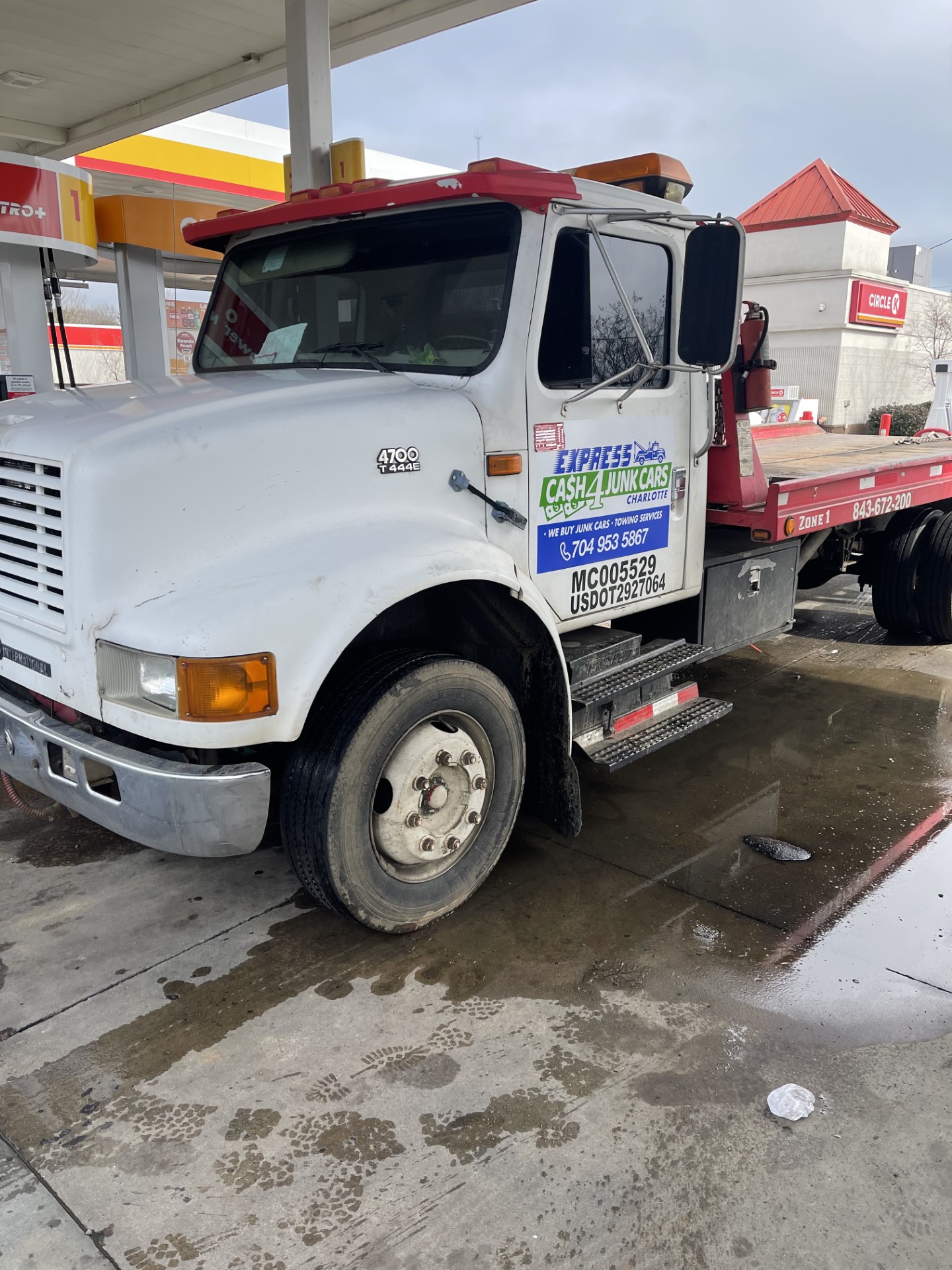
Why damaged cars usually pay better when you skip the body shop
We buy damaged cars in Charlotte — wrecks, hail, flood, fire, rollovers. Call or text with the year, make, model, and a quick description of the damage. You get a cash number on the phone.
If insurance totaled the car and you kept the salvage, send us their offer. We often pay more because we know what the parts are worth locally instead of bidding on volume.
No insurance involved? That's fine too. Same process: tell us what happened, get a quote, schedule a free tow truck. Cash on pickup.
We run damaged car buying pickups across the Charlotte metro every week. Most of our volume comes out of Charlotte, Concord, Gastonia, Huntersville, and Matthews — but we buy across 20+ other cities in the area too. Ready to move? Get a cash offer for your junk car or check what your car is worth on our junk car value guide.
Owners who land on this page often also need wrecked car buying, junk car removal, car with mechanical problems, fire-damaged car buying, flood-damaged car buying, or missing catalytic converter car buying — same tow truck, same crew, same cash-on-pickup pay. If you're not sure which one actually describes your situation, start with our our Charlotte service page and we'll sort it out on the call.
Two vehicles dominate our damaged car buying pickup log in the Charlotte metro: the ford f-150 (5.4 Triton and 3.5 EcoBoost issues are the most common F-150 trigger) and the jeep grand cherokee (Pentastar head failure and Hemi lifter wipes). If yours is one of those, the linked guide has model-specific failure codes, generation breakdowns, and recent Charlotte purchase ranges.
Damage situations we deal with every week
Total loss from insurance
Kept the salvage after a total-loss payout? Send us the offer. We usually beat the insurer's salvage bid.
Frame damage
Bent frame kills private-sale value. We buy frame-damaged cars every week and quote honestly.
Hail or flood damage
We buy both, running or not. Most get picked up within 24 hours.
Fire damage
Engine, electrical, or burned-out shells — still has parts and scrap value. Get it off the property and walk away with cash.
Rollover or airbags deployed
Repair costs almost always exceed value. We pay parts-and-scrap, usually more than the salvage auction.
Recent damaged car buying pickups in the Charlotte area
Problem: Wrecked front-end after I-485 collision
Reason for selling: Insurance totaled at low payout
Outcome: Beat the salvage bid by $700, picked up in Charlotte
Problem: Hail damage from spring storm
Reason for selling: Owner didn't want to claim and raise rates
Outcome: Towed from a Mooresville driveway, cash paid
Problem: Flood damage after heavy rain
Reason for selling: Insurance deductible exceeded payout
Outcome: Picked up in Belmont, cash same day
Problem: Rollover, airbags deployed
Reason for selling: Insurance paid out, owner sold the salvage
Outcome: Bought in Gastonia, beat the salvage auction bid
Problem: Engine fire, complete loss
Reason for selling: Owner needed it gone before next storage bill
Outcome: Free tow truck from a Concord lot
Problem: Front-end collision, deployed airbags, hood and both fenders crumpled, engine intact and previously running
Reason for selling: Insurance totaled it; owner kept the salvage and wanted it gone before HOA notice
Outcome: $1,450 cash, tow truck pickup the same afternoon from a Quail Hollow driveway
Problem: Rear-end collision in stop-and-go traffic, bent bed and tailgate, drivetrain untouched, 178k miles
Reason for selling: Repair quote came in at $6,200; owner already bought a replacement truck
Outcome: $2,100 cash paid curbside, picked up next morning from a townhome in Christenbury
Problem: Side-impact T-bone, driver door and B-pillar buckled, airbags deployed, car still cranked but wouldn't shift
Reason for selling: Student totaled it; family didn't want it sitting in the apartment lot
Outcome: $1,675 cash, picked up from a complex off W.T. Harris Blvd, leasing office notified by us
Problem: Hood and front clip from a deer strike, radiator pierced, truck no longer running but otherwise straight
Reason for selling: Owner didn't want to put $3,000 into a 17-year-old work truck
Outcome: $1,225 cash, picked up from a fenced commercial yard off Franklin Blvd same day
Problem: Hail total from a spring storm — roof, hood, trunk, fenders all dimpled; glass intact; runs and drives
Reason for selling: Insurance settled with owner keeping the salvage; he didn't want to repair or drive it
Outcome: $4,800 cash, picked up the same day from a private driveway off Rea Road
When repair quotes pass the value of the car
Collision repair adds up fast: bumper $1,500–$3,000, fender or door $2,000–$5,000, frame work $1,500+, airbags $1,000–$2,500 each, post-flood electrical $5,000+.
Sell the car instead and none of that comes out of your pocket. Cash offer is yours to keep.
There's a real difference between a local Charlotte junk car buyer and a national online vehicle buying service. National services generate the offer centrally and arrange collection through independent carriers or partner buyers, which they publish on their own sites. A local buyer prices the car itself and sends its own truck. That is a structural difference in who you deal with and who shows up; which offer is higher depends on the vehicle.
When you call Express Cash For Junk Cars Charlotte, you talk directly to the buyer making the offer — no dispatcher in another state, no script being read at you. We know the Charlotte parts market because we operate in it every day, so our offers reflect current local demand for your vehicle. If you already have another offer, bring it and we will tell you honestly whether we can do better.
How We Calculate Your Offer On A Damaged Car
Our cash offer on a damaged car job isn't a guess and it isn't a flat scrap-weight number. It's built from four real inputs: current scrap steel pricing per ton at the Charlotte-area mills we deliver to, the auction value of usable parts pulled off your specific year/make/model, the cost of the tow and labor to get the vehicle there, and a small operating margin. When parts demand is hot — which it almost always is on common Charlotte vehicles like the F-150, Camry, Civic, and Silverado — the parts side of that equation pushes our offer well above pure scrap value.
On damaged vehicles specifically, the biggest swing factor is which panels and mechanicals are still salvageable. A front-end collision that left the engine, transmission, and rear half of the vehicle intact usually pays substantially more than a rear-impact that bent the unibody. A roll-over that crushed the roof but left the drivetrain untouched still has real value because engines, transmissions, axles, fuel systems, and rear suspensions all part out fast. On top of that, we adjust for things that genuinely move the number: catalytic converters present (or not), aluminum wheels vs steel, condition of the bed/tailgate on pickups, body panels that are still straight, and whether the interior is intact enough to part out seats and trim. None of those adjustments are hidden — if you ask the dispatcher to walk through how your specific number was built, they will, line by line.
Mileage matters less than most sellers expect. We're not buying the vehicle to drive it, so the difference between 140,000 and 240,000 miles barely moves the offer. What moves the offer is whether the engine is intact (even if seized), whether the transmission is still bolted in, whether the wheels and tires are still on the ground, and whether the catalytic converter is in place. Those four items account for most of the variation between two otherwise identical-looking vehicles.
One thing we never do is bait-and-switch. The number quoted over the phone is the number paid at the curb, in cash, the same day. If we get to your driveway and the vehicle is materially different from what you described, we'll talk it through before the truck leaves — but we don't shave a hundred dollars off "for the tow" or "for the title" or "for the converter being scratched." Those tricks are why so many people have a bad story about selling a junk car. We built this company on not being that.
What Happens On Pickup Day For A Damaged Car
Pickup day for a damaged vehicle pickup runs the same way every time. After you accept the offer, our dispatcher locks a two-hour arrival window that fits your schedule — most sellers pick a morning slot so the car is gone before lunch. The driver calls roughly 30 minutes out so you're not stuck waiting on the porch, and again when he turns onto your street. If you live in an apartment, gated community, or business park, that call is your cue to meet him at the gate or guard shack so he isn't circling the property.
When the tow truck arrives, the driver does a quick walk-around to confirm the vehicle matches what you described on the phone — same year, same body style, same general condition. As long as nothing major has changed since the quote (the engine isn't suddenly stripped, the wheels are still on it, the title still matches the VIN), the number you were quoted is the number you get paid. We don't renegotiate at the curb. If something genuinely is different, the driver will call dispatch and we'll talk it through with you before anyone signs anything.
Title transfer happens curbside on the hood of the truck. You sign the title over to us as buyer, we hand you the agreed cash in full — counted out in front of you — and you keep a written bill of sale with the VIN, mileage, date, and our company information for your records. Take a photo of the title and the bill of sale before the truck leaves; that's your proof for the NCDMV when you cancel the registration and drop the plate.
Loading takes about ten to fifteen minutes on a normal driveway pickup. The tow truck tilts back, we winch the vehicle up (even with no key, no battery, and flat tires), strap it down at four points, and we're gone. Driveways aren't damaged, lawns aren't rutted, and any fluid drip on the concrete gets a quick absorbent treatment before we leave. Then the car is off your property for good — no return trip, no follow-up paperwork, no surprise calls a week later.
Title And Paperwork Requirements For Damaged Vehicles
Title and paperwork on a damaged car sale follow North Carolina rules, and the short version is: clean title in the seller's name is the easiest path. Sign the back of the title as seller, fill in our company name as buyer, write in the odometer reading and sale date, and that's the entire transaction on your end. We provide a bill of sale, and you take the license plate off the vehicle before the tow truck leaves — North Carolina plates stay with you, not the car. Drop the plate at any NCDMV office (or mail it in with a Plate Surrender form, MVR-18A) and your registration is officially closed.
Insurance claims add one wrinkle: if you filed a claim and the insurer paid out, the title may already show a salvage or total-loss brand. That's fine — we buy salvage and rebuilt titles every week, and the brand doesn't lower the offer by as much as most sellers expect. What you do need is the actual title document in hand. If the insurance company is still holding the title because the claim hasn't fully closed, wait for them to release it before we send a truck; otherwise we end up with a partial transaction and you with no closure.
If the title is in someone else's name — a deceased relative, an ex-spouse, a previous owner who never transferred it — we work through it case by case. North Carolina recognizes several alternate paths: a Year-and-a-Half / abandoned-vehicle title under G.S. 20-77, an heir affidavit (MVR-317) for inherited vehicles under $30,000 with no probate, a duplicate title application (MVR-4) if the original is lost but the registration is in your name, or a small-estate affidavit for probate situations. On the call, tell us exactly whose name is on the title and how the vehicle came into your possession — we'll tell you which path applies before we send a truck.
Lien releases trip up more sales than missing titles do. If the title shows a lienholder (a bank, credit union, or finance company) at the top, that lien has to be released before we can buy the vehicle. Most lienholders will mail or email a lien release letter once the loan is paid off, but the paperwork often gets lost in a move or a name change. If the loan was satisfied years ago and you never got the release, call the lienholder and request a duplicate release letter — it's free and usually takes a week. We'll wait on it; we'd rather wait a week than do a bad-paper transaction.
Photo ID matches the title name. That's it for the paperwork. We don't ask for proof of insurance (the vehicle isn't being driven away), we don't ask for the original purchase receipt, we don't ask for service records. Title, ID, plate off the car — three items, ten minutes at the curb, paid in full.
Charlotte Area Pickup Logistics For Damaged Vehicles
Charlotte pickup logistics aren't one-size-fits-all, and damaged car jobs sit in some of the trickiest spots in the metro. We run tow trucks out of a Charlotte yard, which lets us reach NoDa, Plaza Midwood, Dilworth, South End, Ballantyne, University City, Steele Creek, and the airport corridor inside the I-485 loop in under an hour from dispatch. Outside the loop — Concord, Kannapolis, Mooresville, Huntersville, Cornelius, Davidson, Matthews, Mint Hill, Indian Trail, Monroe, Gastonia, Belmont, Pineville, Fort Mill, Rock Hill — we run scheduled routes daily, usually with same-day or next-morning availability.
Apartment complex pickups are routine. Most Charlotte complexes (think the corridors off South Tryon, Albemarle Road, Sharon Amity, and University City Blvd) require either a visitor parking spot or coordination with leasing. We send a regular tow truck rather than a heavy wrecker so we fit through standard gate arches and parking-deck clearance bars — most decks in South End, Uptown, and Plaza Midwood have a 7-foot clearance, and our tow truck clears that with the boom down. If your complex requires a tow notice or a leasing-office sign-off, tell us on the call and we'll handle the paperwork the morning of pickup.
HOA neighborhoods — particularly in Ballantyne, Highland Creek, Eastover, Myers Park, and the Lake Norman communities — sometimes have rules about how long an inoperable vehicle can sit visible, and sometimes have rules about commercial tow trucks on the street. We pull up, hook up, and clear out, usually inside fifteen minutes from arrival to taillights leaving the cul-de-sac. No signage on the truck pointing at your house, no engine left running in the driveway for an hour. If your HOA requires advance notice, mention it on the call and we'll coordinate.
Business and commercial pickups (auto shops in NoDa and West Charlotte clearing out lot inventory, dealership trade-ins, body-shop totals, fleet retirements out of the airport-area logistics parks) get prioritized scheduling. We can pick up multiple vehicles in one trip and consolidate paperwork into a single bill of sale per VIN. For ongoing relationships — body shops moving 4-8 totals a month, for example — we set a standing pickup day and a flat per-vehicle offer schedule so there's no back-and-forth on every car.
Same-day scheduling is the default, not the exception. Call before about 11 AM and we routinely have a driver at your address by mid-afternoon. Call after lunch and next-morning is normal. The only times we genuinely can't hit same-day are during severe weather (ice storms shut everything down for a day or two each winter) or when the entire fleet is already booked, which mostly happens after the first of the month when end-of-lease and tax-refund clean-outs spike volume.
Specific Damage Types We Buy Every Week
Front-end collision damage is the most common condition on our daily route. Deployed airbags, crumpled hoods, bent radiator supports, pushed-back fenders, broken headlight assemblies — none of it stops us from making a real offer. The engine on most front-end hits is fine (the crumple zones did their job), and a running drivetrain with body damage is exactly the profile parts buyers are looking for. Charlotte's I-77, I-485, and I-85 corridors generate a steady supply of these vehicles; we know the patterns, and the offers reflect it.
Rear-end damage is usually cleaner mechanically but messier structurally. The trunk floor, rear quarter panels, and bumper support all absorb the hit, and on unibody vehicles that can mean frame straightening that costs more than the car is worth. We buy them as-is. The drivetrain, front clip, doors, and interior all retain value, and we don't deduct extra for cosmetic damage to the rear panels — that's already priced in.
Side-impact damage (T-bones, swiped doors, hit-and-run parking-lot damage) is the trickiest to assess sight-unseen because side hits can range from a scraped door skin to a fully buckled B-pillar. When you call, describe how far the damage extends — just the outer skin, or did the door stop closing, or did the window frame distort. The more accurate that description, the closer the phone quote will be to the final number at the curb.
Hail damage and storm damage on otherwise intact vehicles are some of the easiest buys we do. Hood, roof, and trunk panels are dimpled, paint may be cracked, glass might be cracked or broken — but the vehicle still runs and drives. Insurance often totals these because PDR (paintless dent repair) on a full vehicle runs $4,000-$8,000, but the mechanical value is essentially untouched. We pay strong numbers on hail totals because they're easy to part out or wholesale to the export market.
Flood-line damage that crosses into electronics territory is a separate category — see our flood-damaged car page for that specific situation. But shallow water exposure that didn't reach the seats or the ECU is treated as standard damaged-car inventory and priced accordingly.
How To Sell A Damaged, Wrecked Or Totaled Car In Charlotte
Most people who reach this page are trying to figure out how to sell a damaged car without pouring another dollar into it. The short version: you don't repair it, you don't detail it, and you don't get it inspected. You call with the year, make, model and a plain-English description of what's wrong, and you get a number. If you want to sell a wrecked car that's been sitting since the accident, the process is identical — the tow truck handles vehicles that won't start, won't steer, and won't roll.
Sellers who want to sell a totaled car are usually in one of two spots. Either the insurer already declared it a total loss and you retained the vehicle, or you're still deciding whether to accept their salvage offer. In the first case you have a salvage-branded title and we buy it as-is. In the second case, get our number before you sign the insurance release — retained-salvage payouts and a direct cash offer are two different figures, and it costs nothing to compare them side by side.
Body-shop quotes are the usual tipping point. Once the estimate crosses what the car would be worth repaired, repairing stops being a financial decision and becomes an emotional one. That's the moment most Charlotte drivers decide to sell the damaged car outright, take the cash, and put it toward the next vehicle instead of toward a straightened unibody they'll have to disclose forever.
Recent Charlotte Area Vehicle Purchases
A snapshot of recent cash offers paid on pickup across the Charlotte metro.
- 2011 Dodge ChargerFort Mill, NC$675
- 2018 Volkswagen JettaIndian Trail, NC$850
- 2002 Jeep Grand CherokeeConcord, NC$375
- 2017 Chrysler 200Kannapolis, NC$350
- 2014 Lincoln MKZHuntersville, NC$450
- 2009 Volvo S60Fort Mill, NC$300
Offers vary by year, make, model, condition, location, and current scrap-metal pricing.
Charlotte Neighborhoods & Surrounding Communities We Serve
Local tow truck routes covering the City of Charlotte plus every major commuter community in Mecklenburg, Cabarrus, Union, Gaston, and Iredell counties. Same-day or next-morning pickup on most calls.
- University City
- Ballantyne
- SouthPark
- Steele Creek
- NoDa
- Plaza Midwood
- Mint Hill
- Matthews
- Huntersville
- Concord
- Gastonia
- Monroe
- Pineville
- Belmont
- Cornelius
- Davidson
- Harrisburg
- Indian Trail
- Kannapolis
Popular Searches
- Cash For Junk Cars Charlotte
- Cash For Cars Charlotte NC
- We Buy Junk Cars Charlotte NC
- Junk Cars For Cash Near Me
- Sell My Junk Car Charlotte
- Junk Car Buyer Charlotte
- Top Dollar For Junk Cars Charlotte
- Same Day Junk Car Pickup Charlotte
- How Much Is My Junk Car Worth
- Get A Cash Offer Today
- $500 Cash For Junk Cars
- Who Pays The Most For Junk Cars
- We Buy Junk Cars No Title
- Junk Car Removal Charlotte
- Sell Wrecked Car For Cash
- Junkyards Near Me Charlotte
Get your offer & key destinations
Areas we serve
Learn more about: our other services
Frequently asked questions
Have a damaged car you want gone?
Get a real cash offer in minutes. Free towing. Same-day pickup. Paid the moment we arrive.
Earn Money Referring Vehicle Sellers
Mechanics, body shops, tow companies, dealerships, tire shops, transmission shops, and salvage yards can earn referral payments when customers sell their vehicles through Express Cash For Junk Cars Charlotte.
- Local Charlotte buyer
- Fast response times
- Same-day vehicle pickup available
- Direct communication
- Referral payments available
A professional, local partnership program — not affiliate marketing. Apply in 60 seconds.
Become A Partner Call 704-953-5867