
- Since 2016Local Charlotte buyer since 2016Local Charlotte buyer since 2016
- Any conditionWe Buy Cars In Any ConditionWe Buy Cars In Any Condition
- 1,000s boughtThousands of Vehicles PurchasedThousands of Vehicles Purchased
- Cash on pickupCash Paid On PickupCash Paid On Pickup
- Free towingFree Same-Day TowingFree Same-Day Towing
- Charlotte metroCharlotte, Mecklenburg & Surrounding AreasCharlotte, Mecklenburg & Surrounding Areas
Sell A Car That Failed NC Inspection In Charlotte
We buy cars in the Charlotte area that failed NC safety or emissions inspection. The repair list does not need to be completed before sale. Free towing included.
Get your free cash offer
- Failed at an NC inspection station — we'll still buy it
- P0420, P0430, evap, O2, readiness — quoted without the report
- Tags expired because of the failure? No problem
- Free tow truck, cash at the curb, registration headache ends today
What happens after you submit
- 1We price your exact vehicle
Year, make, model, condition and title status are checked against current scrap and salvage numbers.
- 2A local buyer calls you
You get a real number from a Charlotte dispatcher — not an automated range.
- 3We schedule the tow
Towing is included. Pickups run Monday–Saturday; no Sunday pickups.
- 4You get paid at the curb
Cash, Zelle, or Apple Pay when the paperwork is signed.
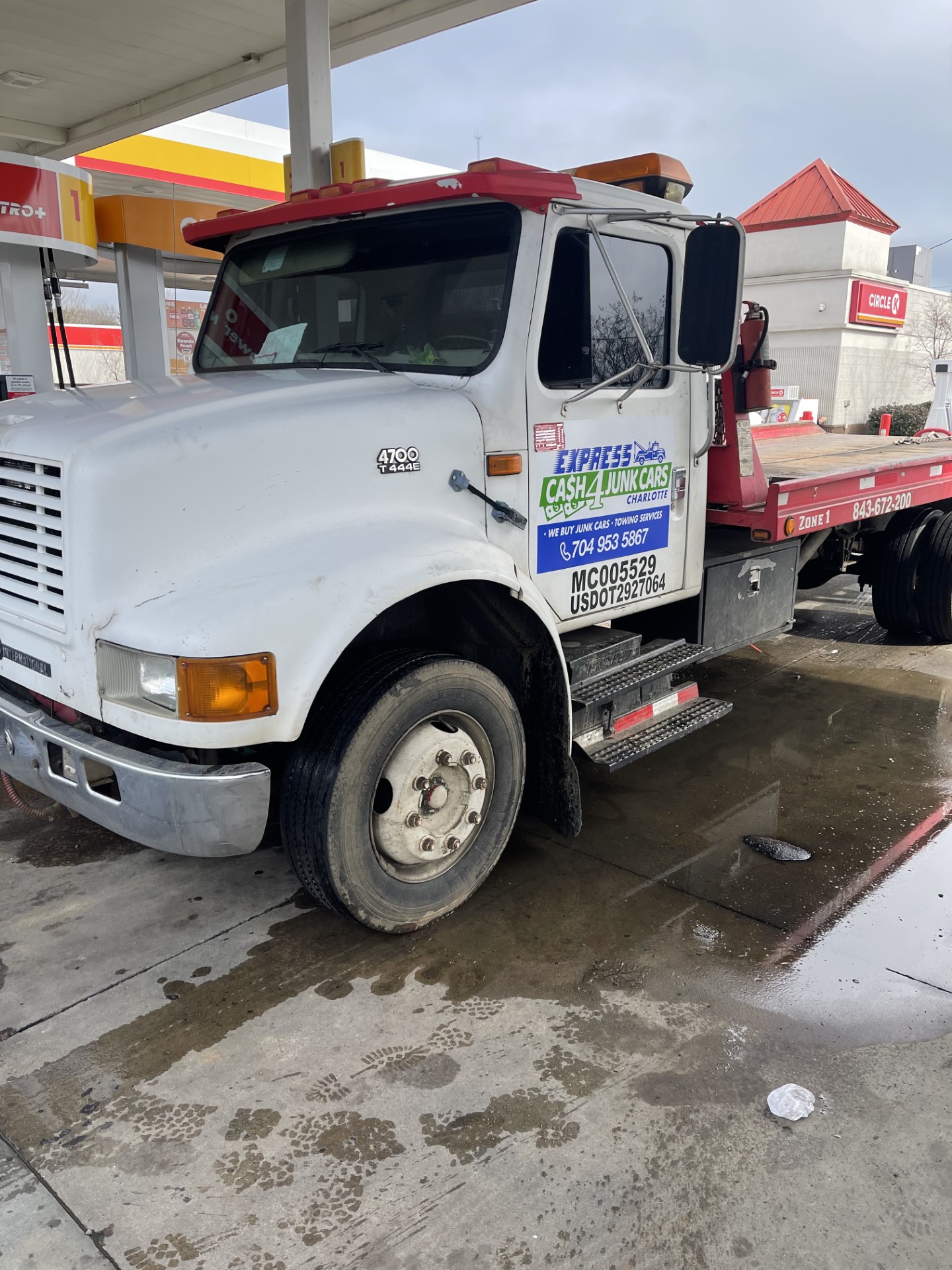
Common reasons vehicles fail inspection in North Carolina
North Carolina runs its vehicle inspection program under G.S. 20-183 and 19A NCAC 03D, administered by NCDOT and enforced through licensed inspection stations (every shop with the green-and-white 'NC Inspection Station' sign). Every passenger vehicle registered in NC requires an annual safety inspection. Vehicles registered in the 19 emissions-program counties — Mecklenburg, Cabarrus, Gaston, Union, Iredell, Lincoln, and the rest of the I-77/I-85 corridor — also require an OBD-II emissions inspection at the same visit. A failed inspection means the registration cannot be renewed at NCDMV until the issue is corrected and a passing re-inspection is logged in the state's electronic system. There is no paper sticker anymore; the result is recorded electronically and visible to NCDMV in real time. This page is specifically about that situation: a vehicle that failed at an NC station, a registration that is blocked or about to be, and an owner deciding whether the repair list is worth chasing.
The most common NC emissions-inspection failure is the OBD-II monitor failure — the inspection requires that all readiness monitors have completed a drive cycle and that the check-engine light is off. The fault codes that show up most often in our service area are P0420 (catalyst efficiency below threshold, bank 1), P0430 (same, bank 2), P0455 and P0457 (evap system large leak, often the gas cap or charcoal canister), P0171/P0174 (system lean, MAF or vacuum leak), and any persistent misfire code (P0301-P0308). Each of these has a real repair: an OEM catalytic converter is $1,500-$3,500 installed; an evap canister is $300-$900; MAF sensor and intake gasket work is $400-$900; misfire repairs depend on cause. On a 12-year-old car, none of those quotes are easy to swallow when stacked together.
The safety side of the program produces a different set of failures and the same financial conclusion. NC safety inspection covers brakes (linings, lines, hoses, master cylinder), steering and suspension (ball joints, tie rod ends, control arm bushings, wheel bearings, play in the wheel), tires (tread depth minimum 2/32", no exposed cord or sidewall damage), lighting (every required lamp functional), windshield (no cracks in driver's primary view), exhaust (no leaks ahead of the muffler), and a handful of body and frame items. A rusted brake line is $400-$900 to replace; ball joints and tie rods run $200-$500 each; a windshield in the driver's view is $300-$700; brake rotors and pads $400-$700 per axle. When two or three safety failures stack on the same inspection report — common on cars past 150,000 miles in our high-humidity, road-salt-in-winter NC market — the combined repair quote routinely runs $1,500-$3,000 before any emissions repairs are added on top. NCDMV does not accept partial repairs. The car either passes a fresh inspection or the registration stays blocked.
We run failed nc inspection car buying pickups across the Charlotte metro every week. Most of our volume comes out of Charlotte, Concord, Gastonia, Huntersville, and Matthews — but we buy across 20+ other cities in the area too. Ready to move? Get a cash offer for your junk car or check what your car is worth on our junk car value guide.
Owners who land on this page often also need check engine light car buying, missing catalytic converter car buying, car with mechanical problems, transmission failure car buying, head gasket car buying, or flood-damaged car buying — same tow truck, same crew, same cash-on-pickup pay. If you're not sure which one actually describes your situation, start with our our Charlotte service page and we'll sort it out on the call.
What usually triggers a failed NC inspection
Failed for P0420 or P0430 catalytic efficiency
The cat is no longer converting hydrocarbons and CO above the federal threshold the OBD-II system enforces. OEM converter replacement on most modern vehicles runs $1,500-$3,500 installed; California-spec or hybrid-applicable cats run higher. Aftermarket EPA-compliant cats sometimes pass for a few thousand miles and then re-trigger the code. Many owners decide one replacement is enough.
Failed for OBD readiness monitors not complete
If codes were recently cleared (battery disconnect, scan-tool reset), the OBD-II system needs a drive cycle to set readiness monitors. Some monitors take 50-100 miles of mixed driving to set. If the underlying fault re-triggers a code before the cycle completes, the monitor never sets and the inspection cannot pass. Owners chase this loop for weeks.
Failed for evap leak (P0440, P0442, P0455, P0457)
Evap codes range from a $20 gas cap to a $400 charcoal canister to a $800-$1,500 evap line repair depending on where the leak is. Some evap leaks only set the code under specific temperature and fuel level conditions, making diagnosis frustrating across multiple shop visits.
Failed safety for rusted brake lines or rotted exhaust
Decade-plus of NC road salt and humidity rusts brake lines from the inside. Replacement is $400-$900 for a single line; full system replacement runs $1,200-$2,000. Exhaust leaks ahead of the muffler also fail safety; CARB-compliant manifold work or full exhaust replacement runs $600-$2,500 depending on platform.
Failed safety for ball joints, tie rods, or steering play
The state inspector checks for play in the steering and suspension by lifting the wheel and shaking it. Worn ball joints, tie rod ends, idler arms, or wheel bearings all fail. Each component runs $200-$500 installed; multiple worn parts on the same axle stack into four-digit quotes.
Registration renewal blocked at NCDMV until inspection passes
NCDMV will not issue a renewed registration card until a passing inspection is logged in the state's electronic system. Driving on expired tags adds citation risk and additional fees. Selling the car closes both the inspection problem and the registration problem at the same time.
Recent failed NC inspection car buying pickups in the Charlotte area
Problem: Failed emissions P0420 cat efficiency
Reason for selling: OEM cat quoted at $2,100 installed
Outcome: $500 cash from a narrow alley driveway
Problem: Failed safety: brake lines plus front ball joints
Reason for selling: Stacked repair quote was $1,475
Outcome: $450 paid from a single-family driveway
Problem: Failed safety: rotted rear brake lines
Reason for selling: Owner upgraded vehicle instead of repairing
Outcome: $425 cash from a covered carport
Problem: Failed emissions: persistent P0420 after cat replacement
Reason for selling: Second cat in 18 months
Outcome: $500 paid from an HOA driveway
Problem: Failed safety: outer tie rods and inner tie rods
Reason for selling: Couldn't renew registration in time
Outcome: $400 cash from an apartment parking lot
Problem: Failed emissions: evap and exhaust leak
Reason for selling: Repair quote exceeded private-party value
Outcome: $425 paid from a duplex driveway
Problem: Failed emissions: cat plus rear brakes
Reason for selling: Owner replaced with newer minivan
Outcome: $475 cash from a single-family driveway
Problem: Failed safety: frame rust at front control arm mounts
Reason for selling: Couldn't justify the structural work
Outcome: $500 paid from a residential driveway
Problem: Failed emissions plus tires below 2/32"
Reason for selling: Tags expired during the repair window
Outcome: $450 cash from an HOA driveway
Problem: Failed emissions: missing catalytic converter (theft)
Reason for selling: Second cat theft on the same truck
Outcome: $750 paid from a long gravel driveway
Problem: Failed emissions for P0420 cat efficiency code, intermittent check-engine light, drives fine
Reason for selling: Repair quote $1,400 for new cat on a car worth $2,200 trade-in; owner declined
Outcome: $1,125 cash, picked up the same day from a Park Road area driveway
Problem: Failed safety for ball joint play, exhaust leak, bald tires; failed emissions for two O2 sensor codes
Reason for selling: Stacked repair quotes exceeded $2,200 on a car worth $1,400 trade-in
Outcome: $675 cash, free tow truck pickup from a single-family driveway off Franklin Blvd
Problem: Failed emissions, CVT also slipping, registration expired 8 months ago after second re-inspection failure
Reason for selling: Owner stopped driving it after the second fail; finally cleared the driveway
Outcome: $895 cash, picked up next morning from a townhome driveway off Independence Blvd
Problem: Failed safety for brake line corrosion, parking brake non-functional, transmission also weak
Reason for selling: Mechanic recommended scrapping after seeing the brake lines and the trans codes together
Outcome: $525 cash, picked up the same week from a residential driveway off NC-49
Problem: Failed emissions for incomplete monitors after head-gasket repair, then failed again for new codes
Reason for selling: Owner was on the third re-inspection attempt; decided to be done with the car
Outcome: $1,250 cash (Subaru drivetrain parts demand stayed strong), picked up from a row-house driveway
When inspection repairs stop making financial sense
NC inspection-failure repair quotes vary widely by line item. OEM catalytic converter: $1,500-$3,500 installed. Aftermarket EPA-compliant cat: $400-$1,200 (may or may not pass the next inspection depending on downstream O2 sensor response). Evap canister or line repair: $200-$1,500. Brake line replacement: $400-$1,800 depending on how many. Ball joint per side: $250-$500. Tie rod inner/outer per side: $200-$450. Windshield in driver's view: $300-$700 for most vehicles, more for ADAS-equipped. When two or three of these stack — common pattern on a 12-year-old NC vehicle — the combined quote routinely exceeds half the car's clean-title value. NCDMV does not accept partial repair; the car either passes a fresh inspection or it doesn't.
Selling the failed-inspection car closes every line item at once. The tow truck arrives, the cash is counted, the vehicle leaves your property, the inspection deadline stops mattering, and the registration block is no longer your problem. We do not require the inspection rejection paperwork or the shop estimates to quote — describe what failed in plain language and that is enough.
There's a real difference between a local Charlotte junk car buyer and a national online vehicle buying service. National services generate the offer centrally and arrange collection through independent carriers or partner buyers, which they publish on their own sites. A local buyer prices the car itself and sends its own truck. That is a structural difference in who you deal with and who shows up; which offer is higher depends on the vehicle.
When you call Express Cash For Junk Cars Charlotte, you talk directly to the buyer making the offer — no dispatcher in another state, no script being read at you. We know the Charlotte parts market because we operate in it every day, so our offers reflect current local demand for your vehicle. If you already have another offer, bring it and we will tell you honestly whether we can do better.
How Our Offer Is Built When NC Inspection Has Blocked Your Renewal
The inspection result itself is invisible to our offer math. We do not pay or deduct for the rejection sticker, the failed station name, or the specific code or line item that triggered the failure. What we pay for is the vehicle's actual mechanical and cosmetic condition: drivetrain state, body condition, presence and condition of the catalytic converter, wheels and tires, interior, electronics. The inspection failure is just the trigger that brought you to the decision — the offer reflects what the car is, not why it failed at the station.
One specific failure pattern does change the math: a P0420 or P0430 failure caused by a stolen catalytic converter. The missing cat is a $300-$700 deduction depending on the vehicle (because cats are a meaningful component of the salvage offer). A P0420 caused by an aged-out cat that's still bolted in place is treated normally — the cat is there for us to pull and resell. Tell us on the call whether the cat is present, missing, or aftermarket; that single answer often moves the offer more than any other inspection-related detail.
Pickup Day For A Vehicle With Expired Or Blocked NC Registration
Expired NC tags do not block our pickup — the tow truck loads the vehicle as cargo, not as a road-legal unit. The driver does not need a valid registration sticker on the windshield to put the car on the deck and tow it back. Two practical things change versus a normal pickup: first, you cannot drive the car to meet the truck at a different location even by a few blocks (driving on expired NC tags is enforceable), so the truck comes to where the car actually sits. Second, the registration card and plate stay in your possession after the sale — you walk into any NCDMV office afterward with form MVR-18A and surrender the plate to officially close the registration and stop the annual property tax assessment.
If the failure was for safety items (rusted brake lines, ball joints, tires below 2/32"), the driver also confirms the vehicle is safe to load onto the deck. Most safety failures don't affect loading — we winch the vehicle aboard whether the brakes work or not. Failed steering rarely blocks loading because the wheels are on the ground and the front end is winch-supported up the ramp. Loading takes 12-18 minutes on a typical driveway pickup.
NC Title Transfer When Inspection Has Failed And Registration Is Blocked
An NC inspection failure does not change the title status. The title in your name remains transferable in the normal way: sign the back as seller, write our company as buyer, fill in odometer and sale date, hand it over. The blocked registration renewal is a separate NCDMV record that does not propagate to title transfer. NCDMV's title department and the inspection-program database are different systems; the title clerk at any NCDMV office can process a transfer regardless of inspection status on the same VIN.
What does change is what the new owner can do with the vehicle. As the buyer, we cannot register the vehicle for road use in NC without first making it pass a fresh inspection (which we generally don't — the vehicles we buy this way go to dismantlers or to out-of-state buyers, not to the road). That's our problem, not yours. After the sale, take the plate off the car (NC plates stay with you, not the vehicle), and either return it to NCDMV with form MVR-18A or hold it for transfer to a new vehicle. Either way, your registration ends the day the title transfers.
Charlotte Pickup Logistics For Failed-NC-Inspection Vehicles
Failed-inspection vehicle pickups in the Charlotte area cluster around three specific situations. (1) The vehicle has been sitting since the failure — usually 1-6 months — in the same driveway where the owner was 'going to get to the repair list.' Standard driveway pickup; tow truck handles it. (2) The vehicle was driven to a shop for the repair estimate and is now sitting at the shop with the repair quote unclaimed. We coordinate with the shop directly: shop name, address, owner authorization to release, any storage fees the shop is asking for. (3) The vehicle was driven to a different inspection station for a second-opinion inspection (some owners try a second station hoping for a different result) and is now sitting somewhere off-property. Wherever the car ended up, the tow truck comes to it.
The fastest failed-inspection pickups we do are in the urban core (NoDa, Plaza Midwood, Dilworth, South End, University City) where the vehicle is in a single-family driveway or accessible apartment lot. Slowest are gated HOA communities where guard-shack coordination adds 15-30 minutes (Ballantyne, Highland Creek, the Lake Norman communities). We schedule accordingly and the driver calls 30 minutes before arrival regardless.
NC Inspection Failures We See Most Often
North Carolina requires an annual safety inspection on most vehicles and an annual emissions (OBD-II) inspection in Mecklenburg, Union, Iredell, Cabarrus, Gaston, and surrounding counties. A failure on either side keeps the vehicle from being registered for the next year — meaning the owner either fixes the failure, sells the car, or stops driving it. The third option (stop driving it) is what eventually brings most of these vehicles to us, often a year or two after the inspection failed.
The most common emissions failures we see: check-engine light on at the time of inspection (automatic fail regardless of why), incomplete OBD-II monitors (catalyst, EVAP, O2 sensor monitors not yet "ready"), failed catalytic converter (P0420/P0430 codes), failed EVAP system (purge solenoid, charcoal canister, gas cap leaks), and missing catalytic converter (theft — see our missing-cat page).
The most common safety failures: bald or unevenly-worn tires below the tread minimum, broken or non-functional brake lights and turn signals (often caused by socket corrosion or wiring problems), cracked windshield obstructing the driver's view, worn brake pads to the metal, parking brake non-functional, ball joints with excessive play, and exhaust leaks downstream of the catalytic converter.
What makes inspection failures particularly costly is that one failure often points to others. A car that failed for a check-engine light usually has multiple stored codes; fixing the visible one often reveals the next one. A car that failed for tires often also needs brake work. A vehicle that failed for a missing catalytic converter often has additional theft-related damage to the exhaust hangers and O2 sensor wiring. The "small" repair quote at the inspection station often grows into a much larger bill once a shop has the car on the lift.
Charlotte-area shop labor rates running $130-$180/hr mean that even a single-issue failure (one O2 sensor, one bad ignition coil, one set of brake pads) often comes with 1.5-3 hours of labor on top of parts. Add the cost of a follow-up reinspection (free at most stations in NC, but a return trip nonetheless) and the total commonly exceeds $400-$600 for a "simple" repair. On a vehicle worth $1,500-$3,000 trade-in, owners increasingly do the math and sell.
One specific NC quirk: emissions monitors must be "ready" at the time of inspection, not just absent of codes. After a battery disconnect, ECU reflash, or recent code-clear, the monitors take 50-200 miles of mixed driving to set. A car that "passed" the OBD scan but isn't ready will fail. Owners frequently come to us after the second or third re-inspection attempt, frustrated and ready to be done with the car.
Recent Charlotte Area Vehicle Purchases
A snapshot of recent cash offers paid on pickup across the Charlotte metro.
- 2001 Toyota TacomaIndian Trail, NC$350
- 2007 GMC Sierra 2500Charlotte, NC$525
- 2019 Nissan SentraIndian Trail, NC$475
- 2011 Dodge DakotaCharlotte, NC$475
- 2010 BMW 3 SeriesConcord, NC$500
- 2013 Mercedes C-ClassCornelius, NC$400
Offers vary by year, make, model, condition, location, and current scrap-metal pricing.
Charlotte Neighborhoods & Surrounding Communities We Serve
Local tow truck routes covering the City of Charlotte plus every major commuter community in Mecklenburg, Cabarrus, Union, Gaston, and Iredell counties. Same-day or next-morning pickup on most calls.
- University City
- Ballantyne
- SouthPark
- Steele Creek
- NoDa
- Plaza Midwood
- Mint Hill
- Matthews
- Huntersville
- Concord
- Gastonia
- Monroe
- Pineville
- Belmont
- Cornelius
- Davidson
- Harrisburg
- Indian Trail
- Kannapolis
Popular Searches
- Cash For Junk Cars Charlotte
- Cash For Cars Charlotte NC
- We Buy Junk Cars Charlotte NC
- Junk Cars For Cash Near Me
- Sell My Junk Car Charlotte
- Junk Car Buyer Charlotte
- Top Dollar For Junk Cars Charlotte
- Same Day Junk Car Pickup Charlotte
- How Much Is My Junk Car Worth
- Get A Cash Offer Today
- $500 Cash For Junk Cars
- Who Pays The Most For Junk Cars
- We Buy Junk Cars No Title
- Junk Car Removal Charlotte
- Sell Wrecked Car For Cash
- Cash For Damaged Cars
- Junkyards Near Me Charlotte
Get your offer & key destinations
Areas we serve
Learn more about: our other services
Frequently asked questions
Have a car that failed NC inspection?
Get a real cash offer in minutes. Free towing. Same-day pickup. Paid the moment we arrive.
Earn Money Referring Vehicle Sellers
Mechanics, body shops, tow companies, dealerships, tire shops, transmission shops, and salvage yards can earn referral payments when customers sell their vehicles through Express Cash For Junk Cars Charlotte.
- Local Charlotte buyer
- Fast response times
- Same-day vehicle pickup available
- Direct communication
- Referral payments available
A professional, local partnership program — not affiliate marketing. Apply in 60 seconds.
Become A Partner Call 704-953-5867