
- Since 2016Local Charlotte buyer since 2016Local Charlotte buyer since 2016
- Any conditionWe Buy Cars In Any ConditionWe Buy Cars In Any Condition
- 1,000s boughtThousands of Vehicles PurchasedThousands of Vehicles Purchased
- Cash on pickupCash Paid On PickupCash Paid On Pickup
- Free towingFree Same-Day TowingFree Same-Day Towing
- Charlotte metroCharlotte, Mecklenburg & Surrounding AreasCharlotte, Mecklenburg & Surrounding Areas
High-Mileage Car Buyer In Charlotte
We buy high-mileage vehicles throughout the Charlotte area, including cars and trucks with 200,000 miles or more. Free towing is included with every pickup.
Get your free cash offer
- 150k, 250k, even 400k+ miles — still bought
- Knocking, burning oil, or shifting funny? No problem
- Skip the next big repair bill and pocket the cash instead
- Free towing always included
What happens after you submit
- 1We price your exact vehicle
Year, make, model, condition and title status are checked against current scrap and salvage numbers.
- 2A local buyer calls you
You get a real number from a Charlotte dispatcher — not an automated range.
- 3We schedule the tow
Towing is included. Pickups run Monday–Saturday; no Sunday pickups.
- 4You get paid at the curb
Cash, Zelle, or Apple Pay when the paperwork is signed.
Why high-mileage cars still carry real cash value
Charlotte's commuter culture turns vehicles into high-mileage cars fast. A daily I-77 or I-485 commute is 20,000+ miles a year, and within a decade most family cars are sitting on 200,000-250,000 miles. At that point, every repair feels like a question: spend $1,500 on a new something-or-other, or finally let the car go?
Most high-mileage cars don't fail dramatically. They get tired. Oil consumption creeps up, the transmission starts shifting harder, electronics get glitchy, the AC stops working in summer. Each issue costs $500-$2,000 to fix, and at some point the math stops working — especially on a vehicle that already has limited resale value.
We buy high-mileage cars every week. Honda Accords with 280,000, Camrys with 310,000, F-150s with 240,000 — all of it. We factor remaining parts and scrap value into our offers, which is why we usually beat what scrap-only buyers will quote.
We run high-mileage car buying pickups across the Charlotte metro every week. Most of our volume comes out of Charlotte, Concord, Gastonia, Huntersville, and Matthews — but we buy across 20+ other cities in the area too. Ready to move? Get a cash offer for your junk car or check what your car is worth on our junk car value guide.
Owners who land on this page often also need car with mechanical problems, transmission failure car buying, blown engine car buying, failed nc inspection car buying, check engine light car buying, or no-start car buying — same tow truck, same crew, same cash-on-pickup pay. If you're not sure which one actually describes your situation, start with our our Charlotte service page and we'll sort it out on the call.
Two vehicles dominate our high-mileage car buying pickup log in the Charlotte metro: the toyota corolla (high-mileage 1ZZ oil burners are a Corolla classic in NC) and the toyota camry (2AZ head-bolt failure and high-value cats keep Camry volume steady). If yours is one of those, the linked guide has model-specific failure codes, generation breakdowns, and recent Charlotte purchase ranges.
When a high-mileage car is ready to be sold
Engine burns oil or smokes
Worn piston rings, valve guides, and turbo seals all cause oil burning at high mileage. The fix is often an engine rebuild — $3,000-$6,000 — that exceeds the car's value.
Transmission shifts hard or slips
High-mileage transmissions show their age with delayed shifts, harsh engagements, or occasional slipping. Rebuilds run $1,500-$3,500, often more than the car is worth.
Multiple electrical issues
Power windows, door locks, dashboard warning lights, and intermittent starting problems pile up in high-mileage vehicles. Each repair is small but they never end.
AC has failed
Compressor failures on older cars run $800-$1,500. Once the AC quits, comfort drops fast — but it's rarely a repair that makes sense on a 200k+ mile commuter.
Recent failed inspection
High-mileage cars often need brake lines, exhaust work, or emissions repairs to pass NC inspection. The combined bill makes selling and replacing the smarter move.
Recent high-mileage car buying pickups in the Charlotte area
Problem: Burning oil at 268,000 miles
Reason for selling: Repair didn't make sense at that mileage
Outcome: Picked up in Plaza Midwood, cash on the spot
Problem: Transmission slipping at 295,000 miles
Reason for selling: Owner finally upgraded after 15 years
Outcome: Free tow from a Matthews driveway
Problem: Multiple electrical and AC issues, 245,000 miles
Reason for selling: Owner replaced with newer truck
Outcome: Bought from a Steele Creek home
Problem: Engine knock at 312,000 miles
Reason for selling: Repair quote was 3x the truck's value
Outcome: Same-day pickup in Kannapolis
Problem: CVT shudder at 220,000 miles
Reason for selling: Out-of-warranty CVT not worth fixing
Outcome: Picked up from an Indian Trail apartment lot
Problem: 287,000 miles, original engine and transmission, runs but burns oil and AC quit two summers ago
Reason for selling: Owner's daughter inherited it; failed NC inspection on emissions and brake lines
Outcome: $985 cash, picked up the same day from a driveway off Independence Blvd
Problem: 243,000 miles, VTC actuator rattle on startup, third-row seat motor dead, leather torn
Reason for selling: Family upgraded to a new SUV; trade-in offer at the dealer was $400
Outcome: $1,350 cash, picked up next morning from a lakefront neighborhood off Brawley School Road
Problem: 312,000 miles, spark plug blew out of the head (known 5.4L Triton issue), bed scratched up from work use
Reason for selling: Owner is a contractor; cheaper to buy another used truck than rebuild the head
Outcome: $1,825 cash, tow truck pickup from a residential driveway in Birkdale Village area
Problem: 264,000 miles, transmission slipping in second gear, clear coat peeling, drives but unreliable
Reason for selling: Owner moving out of state and didn't want to drive it cross-country
Outcome: $725 cash, picked up from an apartment complex off North Davidson Street the same afternoon
Problem: 228,000 miles, active fuel management lifter tick, leaking transfer case, otherwise clean body
Reason for selling: Repair shop quote of $4,800 to fix the lifter and reseal the transfer case
Outcome: $2,475 cash, picked up the same day from a single-family home off NC-49
When the next big repair bill costs more than the car is worth
On a vehicle with 200,000+ miles, even routine maintenance feels expensive. Timing belt and water pump together — common on 100k/150k service intervals — runs $700-$1,200. A struts and shocks job is $800-$1,400. Major belts, hoses, and gaskets at high mileage can easily push past $2,000.
We see Charlotte sellers reach a point where the question stops being 'should I fix it' and starts being 'how much more should I spend before letting go?' Our answer is straightforward: get an offer, see if the number works, and put the cash toward something newer. No hard sell — just an option that's usually faster and easier than the next repair.
There's a real difference between a local Charlotte junk car buyer and a national online vehicle buying service. National services generate the offer centrally and arrange collection through independent carriers or partner buyers, which they publish on their own sites. A local buyer prices the car itself and sends its own truck. That is a structural difference in who you deal with and who shows up; which offer is higher depends on the vehicle.
When you call Express Cash For Junk Cars Charlotte, you talk directly to the buyer making the offer — no dispatcher in another state, no script being read at you. We know the Charlotte parts market because we operate in it every day, so our offers reflect current local demand for your vehicle. If you already have another offer, bring it and we will tell you honestly whether we can do better.
How We Calculate Your Offer On A High-Mileage Car
Our cash offer on a high-mileage car job isn't a guess and it isn't a flat scrap-weight number. It's built from four real inputs: current scrap steel pricing per ton at the Charlotte-area mills we deliver to, the auction value of usable parts pulled off your specific year/make/model, the cost of the tow and labor to get the vehicle there, and a small operating margin. When parts demand is hot — which it almost always is on common Charlotte vehicles like the F-150, Camry, Civic, and Silverado — the parts side of that equation pushes our offer well above pure scrap value.
On high-mileage vehicles specifically, parts demand is the dominant factor. A 240,000-mile Camry that still runs has dozens of components worth more individually than the whole car is worth as a trade-in: alternator, starter, AC compressor, radiator, struts, hubs, axles, body panels, glass, interior trim. We're paying for the privilege of pulling those parts in a controlled environment, which means we routinely outbid scrap-only quotes by hundreds of dollars on tired-but-titled vehicles. On top of that, we adjust for things that genuinely move the number: catalytic converters present (or not), aluminum wheels vs steel, condition of the bed/tailgate on pickups, body panels that are still straight, and whether the interior is intact enough to part out seats and trim. None of those adjustments are hidden — if you ask the dispatcher to walk through how your specific number was built, they will, line by line.
Mileage matters less than most sellers expect. We're not buying the vehicle to drive it, so the difference between 140,000 and 240,000 miles barely moves the offer. What moves the offer is whether the engine is intact (even if seized), whether the transmission is still bolted in, whether the wheels and tires are still on the ground, and whether the catalytic converter is in place. Those four items account for most of the variation between two otherwise identical-looking vehicles.
One thing we never do is bait-and-switch. The number quoted over the phone is the number paid at the curb, in cash, the same day. If we get to your driveway and the vehicle is materially different from what you described, we'll talk it through before the truck leaves — but we don't shave a hundred dollars off "for the tow" or "for the title" or "for the converter being scratched." Those tricks are why so many people have a bad story about selling a junk car. We built this company on not being that.
What Happens On Pickup Day For A High-Mileage Sale
Pickup day for a high-mileage vehicle pickup runs the same way every time. After you accept the offer, our dispatcher locks a two-hour arrival window that fits your schedule — most sellers pick a morning slot so the car is gone before lunch. The driver calls roughly 30 minutes out so you're not stuck waiting on the porch, and again when he turns onto your street. If you live in an apartment, gated community, or business park, that call is your cue to meet him at the gate or guard shack so he isn't circling the property.
When the tow truck arrives, the driver does a quick walk-around to confirm the vehicle matches what you described on the phone — same year, same body style, same general condition. As long as nothing major has changed since the quote (the engine isn't suddenly stripped, the wheels are still on it, the title still matches the VIN), the number you were quoted is the number you get paid. We don't renegotiate at the curb. If something genuinely is different, the driver will call dispatch and we'll talk it through with you before anyone signs anything.
Title transfer happens curbside on the hood of the truck. You sign the title over to us as buyer, we hand you the agreed cash in full — counted out in front of you — and you keep a written bill of sale with the VIN, mileage, date, and our company information for your records. Take a photo of the title and the bill of sale before the truck leaves; that's your proof for the NCDMV when you cancel the registration and drop the plate.
Loading takes about ten to fifteen minutes on a normal driveway pickup. The tow truck tilts back, we winch the vehicle up (even with no key, no battery, and flat tires), strap it down at four points, and we're gone. Driveways aren't damaged, lawns aren't rutted, and any fluid drip on the concrete gets a quick absorbent treatment before we leave. Then the car is off your property for good — no return trip, no follow-up paperwork, no surprise calls a week later.
Title And Paperwork For High-Mileage Vehicles
Title and paperwork on a high-mileage car sale follow North Carolina rules, and the short version is: clean title in the seller's name is the easiest path. Sign the back of the title as seller, fill in our company name as buyer, write in the odometer reading and sale date, and that's the entire transaction on your end. We provide a bill of sale, and you take the license plate off the vehicle before the tow truck leaves — North Carolina plates stay with you, not the car. Drop the plate at any NCDMV office (or mail it in with a Plate Surrender form, MVR-18A) and your registration is officially closed.
One quirk on high-mileage sales: the federal odometer disclosure exemption kicks in at 20 model years old. If your vehicle is a 2005 model year or older (in 2026), you don't have to disclose mileage on the title transfer — though you can if you want to. For newer vehicles, write in the actual odometer reading honestly, even if it's rolled over or the cluster has been replaced. We don't care that it's high; we care that it's documented.
If the title is in someone else's name — a deceased relative, an ex-spouse, a previous owner who never transferred it — we work through it case by case. North Carolina recognizes several alternate paths: a Year-and-a-Half / abandoned-vehicle title under G.S. 20-77, an heir affidavit (MVR-317) for inherited vehicles under $30,000 with no probate, a duplicate title application (MVR-4) if the original is lost but the registration is in your name, or a small-estate affidavit for probate situations. On the call, tell us exactly whose name is on the title and how the vehicle came into your possession — we'll tell you which path applies before we send a truck.
Lien releases trip up more sales than missing titles do. If the title shows a lienholder (a bank, credit union, or finance company) at the top, that lien has to be released before we can buy the vehicle. Most lienholders will mail or email a lien release letter once the loan is paid off, but the paperwork often gets lost in a move or a name change. If the loan was satisfied years ago and you never got the release, call the lienholder and request a duplicate release letter — it's free and usually takes a week. We'll wait on it; we'd rather wait a week than do a bad-paper transaction.
Photo ID matches the title name. That's it for the paperwork. We don't ask for proof of insurance (the vehicle isn't being driven away), we don't ask for the original purchase receipt, we don't ask for service records. Title, ID, plate off the car — three items, ten minutes at the curb, paid in full.
Charlotte Area Pickup Logistics For High-Mileage Cars
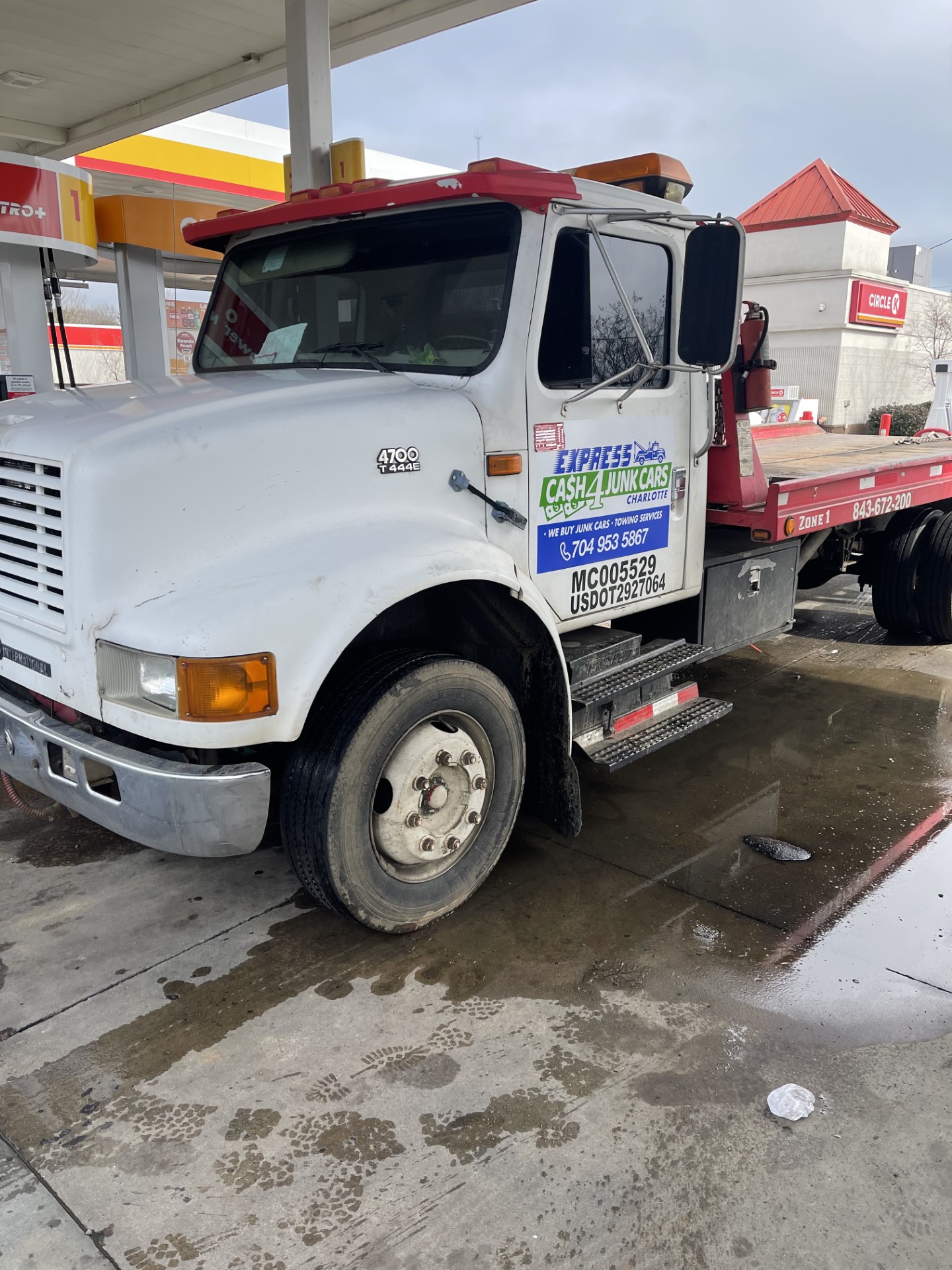
Charlotte pickup logistics aren't one-size-fits-all, and high-mileage car jobs sit in some of the trickiest spots in the metro. We run tow trucks out of a Charlotte yard, which lets us reach NoDa, Plaza Midwood, Dilworth, South End, Ballantyne, University City, Steele Creek, and the airport corridor inside the I-485 loop in under an hour from dispatch. Outside the loop — Concord, Kannapolis, Mooresville, Huntersville, Cornelius, Davidson, Matthews, Mint Hill, Indian Trail, Monroe, Gastonia, Belmont, Pineville, Fort Mill, Rock Hill — we run scheduled routes daily, usually with same-day or next-morning availability.
Apartment complex pickups are routine. Most Charlotte complexes (think the corridors off South Tryon, Albemarle Road, Sharon Amity, and University City Blvd) require either a visitor parking spot or coordination with leasing. We send a regular tow truck rather than a heavy wrecker so we fit through standard gate arches and parking-deck clearance bars — most decks in South End, Uptown, and Plaza Midwood have a 7-foot clearance, and our tow truck clears that with the boom down. If your complex requires a tow notice or a leasing-office sign-off, tell us on the call and we'll handle the paperwork the morning of pickup.
HOA neighborhoods — particularly in Ballantyne, Highland Creek, Eastover, Myers Park, and the Lake Norman communities — sometimes have rules about how long an inoperable vehicle can sit visible, and sometimes have rules about commercial tow trucks on the street. We pull up, hook up, and clear out, usually inside fifteen minutes from arrival to taillights leaving the cul-de-sac. No signage on the truck pointing at your house, no engine left running in the driveway for an hour. If your HOA requires advance notice, mention it on the call and we'll coordinate.
Business and commercial pickups (auto shops in NoDa and West Charlotte clearing out lot inventory, dealership trade-ins, body-shop totals, fleet retirements out of the airport-area logistics parks) get prioritized scheduling. We can pick up multiple vehicles in one trip and consolidate paperwork into a single bill of sale per VIN. For ongoing relationships — body shops moving 4-8 totals a month, for example — we set a standing pickup day and a flat per-vehicle offer schedule so there's no back-and-forth on every car.
Same-day scheduling is the default, not the exception. Call before about 11 AM and we routinely have a driver at your address by mid-afternoon. Call after lunch and next-morning is normal. The only times we genuinely can't hit same-day are during severe weather (ice storms shut everything down for a day or two each winter) or when the entire fleet is already booked, which mostly happens after the first of the month when end-of-lease and tax-refund clean-outs spike volume.
What 'High Mileage' Actually Means In 2026
The threshold for what counts as a "high-mileage" car has shifted dramatically. Twenty years ago, 150,000 miles was the back end of a car's useful life. Today, 200,000 miles is normal on a well-maintained Toyota, Honda, or Subaru, and 300,000 is achievable on a diesel pickup. What changed isn't the car's parts — it's the surrounding economics. New-car prices have outpaced wage growth, used-car prices stayed high after 2021, and insurance, registration, and repair costs all rose in lockstep. The result is that more Charlotte drivers are holding cars deep into the 200,000-mile range than ever before.
What ends a high-mileage car's life now is rarely a single catastrophic failure. More often it's a stack of medium-cost repairs hitting in the same six months — a tired transmission, a leaky head gasket, failing AC, worn struts, a check engine light that the shop can't pin down. Individually each is a $500-$2,000 fix. Stacked together, you're past the trade-in value, and that's when sellers call us.
Mileage above 200,000 doesn't penalize the offer the way most sellers fear it will. The drivetrain might be tired, but it's usually still intact, and that's what we're paying for. A 280,000-mile Civic with a tired clutch pays nearly the same as a 180,000-mile Civic with the same clutch — because the parts on both cars are identical and we're factoring that in.
Where mileage genuinely does hurt the offer is when the high mileage came with deferred maintenance and visible neglect: ripped seats, broken interior trim, rusted body panels (less of an issue in NC than up north, but still real on coastal-area vehicles), missing wheel covers, dented panels. None of that disqualifies the car — it just trims the parts side of the equation. Cars that hit 200,000 miles with intact interiors and straight bodies pay noticeably better than ones that show every mile.
Brand matters more than mileage at this point. A 250,000-mile Tacoma, 4Runner, or Tundra pays better than a 150,000-mile car from a brand with weak parts demand, because the Toyota truck market is hot and dismantlers move those parts in days. A high-mileage F-150, Silverado, or Ram works the same way. Compact and midsize sedans from Toyota and Honda are next in line. Anything past 200k from a brand that's already exited the U.S. market (Suzuki, Saab, Mercury, Pontiac, Oldsmobile) gets paid more on scrap value than parts value, but we still pay competitively — we just won't claim otherwise.
Recent Charlotte Area Vehicle Purchases
A snapshot of recent cash offers paid on pickup across the Charlotte metro.
- 1999 Chevy ColoradoMooresville, NC$400
- 2005 Jeep Grand CherokeeCornelius, NC$325
- 2014 BMW X5Concord, NC$775
- 2014 Mercury SableCharlotte, NC$250
- 2013 Ford FusionHarrisburg, NC$350
- 2003 Chevy TahoeFort Mill, NC$500
Offers vary by year, make, model, condition, location, and current scrap-metal pricing.
Charlotte Neighborhoods & Surrounding Communities We Serve
Local tow truck routes covering the City of Charlotte plus every major commuter community in Mecklenburg, Cabarrus, Union, Gaston, and Iredell counties. Same-day or next-morning pickup on most calls.
- University City
- Ballantyne
- SouthPark
- Steele Creek
- NoDa
- Plaza Midwood
- Mint Hill
- Matthews
- Huntersville
- Concord
- Gastonia
- Monroe
- Pineville
- Belmont
- Cornelius
- Davidson
- Harrisburg
- Indian Trail
- Kannapolis
Popular Searches
- Cash For Junk Cars Charlotte
- Cash For Cars Charlotte NC
- We Buy Junk Cars Charlotte NC
- Junk Cars For Cash Near Me
- Sell My Junk Car Charlotte
- Junk Car Buyer Charlotte
- Top Dollar For Junk Cars Charlotte
- Same Day Junk Car Pickup Charlotte
- How Much Is My Junk Car Worth
- Get A Cash Offer Today
- $500 Cash For Junk Cars
- Who Pays The Most For Junk Cars
- We Buy Junk Cars No Title
- Junk Car Removal Charlotte
- Sell Wrecked Car For Cash
- Cash For Damaged Cars
- Junkyards Near Me Charlotte
Get your offer & key destinations
Areas we serve
Learn more about: our other services
Frequently asked questions
Got a high-mileage car you're done with?
Get a real cash offer in minutes. Free towing. Same-day pickup. Paid the moment we arrive.
Earn Money Referring Vehicle Sellers
Mechanics, body shops, tow companies, dealerships, tire shops, transmission shops, and salvage yards can earn referral payments when customers sell their vehicles through Express Cash For Junk Cars Charlotte.
- Local Charlotte buyer
- Fast response times
- Same-day vehicle pickup available
- Direct communication
- Referral payments available
A professional, local partnership program — not affiliate marketing. Apply in 60 seconds.
Become A Partner Call 704-953-5867